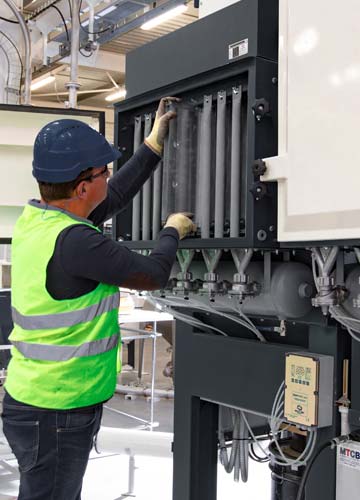
In many industrial sectors, processes generate dust and fumes which, if not properly controlled, can be inhaled by operators and harm their health.
To prevent these risks, local exhaust ventilation captures pollutants directly at the source, before they spread through the workshop. Discover our tailor-made solutions to protect your teams at their workstations.
In many industrial sectors, processes generate dust and fumes which, if not properly controlled, can be inhaled by operators and seriously harm their health — from asthma to the most severe respiratory diseases.
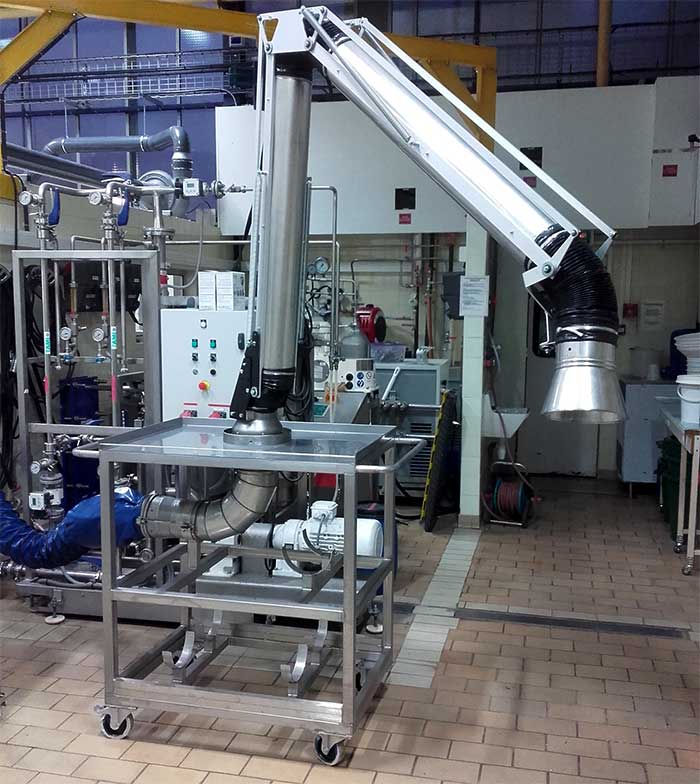
Local exhaust ventilation captures dust, fumes, gases and other contaminants directly at the source, before they spread through the workshop. Installed as close as possible to the workstation, the system extracts the contaminated air, contains the pollutants and purifies the air for a healthy and safe working environment.
To be fully effective, such an installation must be correctly sized, used properly and maintained regularly. The Delta NEU experts support you at every step, from studying your needs to maintaining your system.
Source capture removes dust, fumes, mist, gases and other airborne contaminants. Installed as close as possible to the emission source, it captures pollutants before they can be breathed in by operators.
Captures contaminants at the source
Transports the contaminant
Purifies the air
Draws in and moves the air
Discharges stale air outside
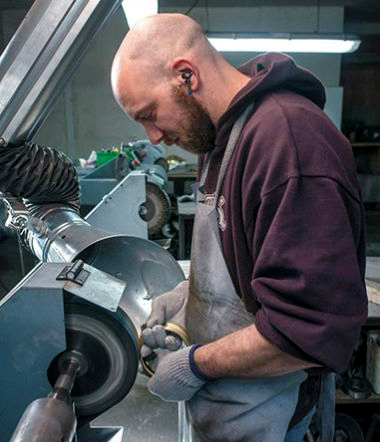
Source capture in a polishing workshop — Parmentier Polissage (Aumale, France)
In its metal-part polishing workshop, Parmentier Polissage exposed its operators to large amounts of dust (copper, aluminium, brass, stainless steel, brush fibres, polishing paste) released directly at the workstation — toxic dust that also presented an explosion risk (ATEX).
Supported by the French INRS and Carsat bodies for bringing its premises into compliance, the company needed a genuinely high-performance dust extraction installation, as the previous one had become inadequate.
Delta NEU installed 6 capture points as close as possible to the emission areas, with hoods adjustable to the size of the parts and the tool used, complemented by an articulated swivel arm for larger parts.
The air is carried through a galvanised-steel ducting network to a cyclone that separates the coarse particles, then to an ATEX bag filter dust collector fitted with a non-return valve. Two drums collect the dust directly into bags, reducing handling. The whole system, kept under negative pressure, captures dust inside the workshop and discharges clean air outside.
Delta NEU designs source-capture solutions tailored to the constraints of each industry. Discover our expertise by sector of activity.
A local exhaust ventilation installation requires special attention: the captured pollutants can affect your operators' health and the safety of your working environment. At Delta NEU, we support you from defining your needs to designing and installing your system.
You can also benefit from the expertise of our Delta NEU Customer Service, which offers a complete range of services: upgrades to optimise performance, maintenance operations and replacement of consumables to preserve the safety of your workstations and anticipate any production stoppage.
Download our documents below, free of charge, to learn more about our workstation ventilation solutions.
Discover the NEU-JKF Delta NEU local exhaust ventilation systems, designed to capture pollutants at the source and protect your operators at the workstation.
Download our presentation brochure and discover the NEU-JKF Delta NEU know-how.
TECHNICAL DOCUMENTATION
Documents and resources
A question or need more information? Feel free to contact us.
DATASHEET

Our ventilation solutions
BROCHURE

NEU-JKF Delta NEU presentation
FAQ · Workstation ventilation
Exposure to fumes or dust at workstations can cause serious respiratory diseases (such as asthma or other chronic respiratory conditions). Installed at the source or in its immediate vicinity, local exhaust ventilation captures dust, fumes, mists, gases and contaminants before operators breathe them in, while containing and purifying the air.
Depending on the workstation layout, several types of equipment can be used:
The design of at-source capture is based on the nine general ventilation principles set out by INRS, the French national institute for occupational health and safety:
The articulated extraction arm (BOA type) must be placed as close as possible to the emission area, using the natural movement of pollutants and making sure that the operator is never between the extraction device and the pollution source.
Yes, a downdraft table extracts particles and recirculates the air into the workspace, provided the dust is non-CMR.
Weighing stations, bag dump stations, flouring or dosing operations can be fitted with dedicated capture connected to a dust extraction or local exhaust ventilation system, to capture emissions as close as possible to the source without hindering the operator.